Coffee-to-Water Ratio: Calculate a Starting Point in Grams
A ratio makes a coffee recipe easier to repeat. It describes how much brewing water you use for each gram of dry coffee, not the amount of drink left in the cup.
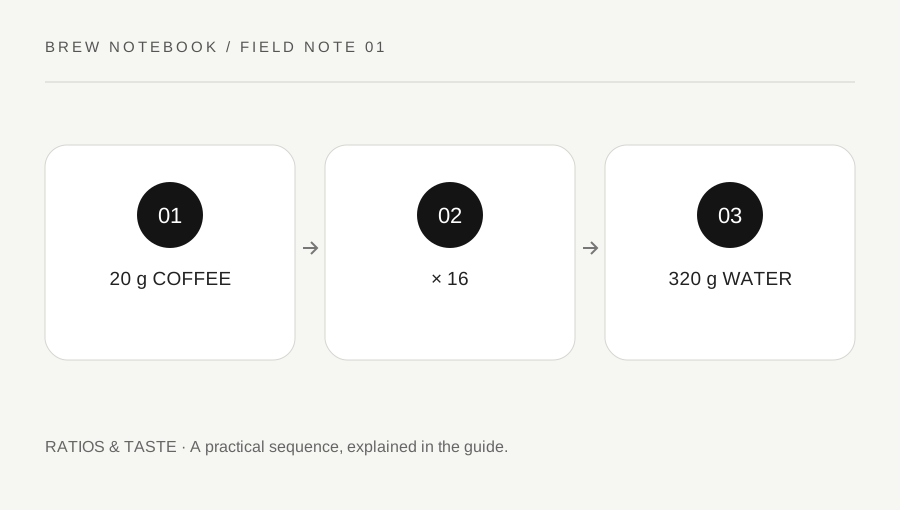
Original explanatory diagram. Numerical examples in this guide illustrate the reasoning; they are not a claim of hands-on testing.
Read the two numbers correctly
At 1:16, each gram of coffee is paired with 16 grams of water. With 20 g of coffee, the water input is 320 g. With 480 g of water available, the dose is 480 ÷ 16 = 30 g. These are arithmetic examples, not universal recipes for every brewer.
The finished beverage weighs less because grounds and equipment retain some water. Do not top up the brewer simply because the liquid in your mug is below the water-input figure. Record input water and beverage output separately when comparing brews.
Choose a baseline, then taste
For a filter-coffee experiment, the calculator starts at 1:16 so the numbers are easy to compare. Start from your brewer or roaster instructions when available. Espresso uses a different convention, usually comparing dry dose with beverage output, and should not be planned with a filter-water calculator.
Try 20 g with 320 g water, then taste once the cup cools enough to drink comfortably. If you want a less concentrated drink, a larger water-to-coffee ratio may help, but extraction changes can also influence flavor. Hold the grind and pouring routine steady while testing the ratio.
Keep the comparison useful
Write down the coffee, dose, water input, grind setting and your short tasting note. Instead of “bad,” try “heavy texture, dry finish” or “lighter than I prefer.” Repeat the baseline before changing three variables at once. The point is a cup you enjoy, not a mathematically impressive number.
For a side-by-side comparison, keep a 20 g dose and compare 300 g with 340 g of water on separate brews. That is 1:15 versus 1:17. Label the cups, let them cool to similar temperatures and choose the result you actually prefer. Do not interpret that small home experiment as a laboratory extraction measurement.
Plan a two-person brew with a capacity check
Suppose you want to use 36 g of coffee for two servings. At 1:16, the input water is 36 × 16 = 576 g. Check that the brewer and receiving vessel can safely accommodate the method and quantity. The number does not guarantee two particular mug volumes because the grounds retain water and mug sizes vary.
If the vessel is too small, choose a smaller batch or brew in stages according to the equipment instructions. Do not squeeze the complete water target into an overflowing filter. If you instead begin with 500 g of water, the dose at 1:16 is 31.25 g. Round only to a precision your scale can support and record the rounded dose.
After brewing, decide whether your issue is the amount of drink, its concentration or its flavor. Those are separate questions. A larger batch at the same ratio changes quantity, while a different ratio changes the relationship between coffee and water. Keep that distinction in your log so the next adjustment addresses the actual problem rather than changing every number at once.
A practical checklist
Tick items for your own use. This checklist is saved only in this browser.
Questions that come up
Does 1:16 work for espresso?
This calculator uses brewing-water input for filter and immersion coffee. Espresso recipes generally use beverage yield and need a separate approach.
Why is there less drink than the water input?
Coffee grounds and equipment retain water. Input ratio and beverage yield describe different measurements.
Can I replace grams with tablespoons?
A spoonful varies with grind and how it is filled. Weighing both inputs gives a clearer, more repeatable relationship.
References & scope
Background references checked on 18 October 2026. The examples and practice exercises are original editorial explanations, not copied procedures or professional advice.