French Press Coffee: Separate the Brewing Plan from the Sediment
A French press keeps grounds in contact with water and separates them with a mesh filter. The texture will differ from paper-filtered coffee.
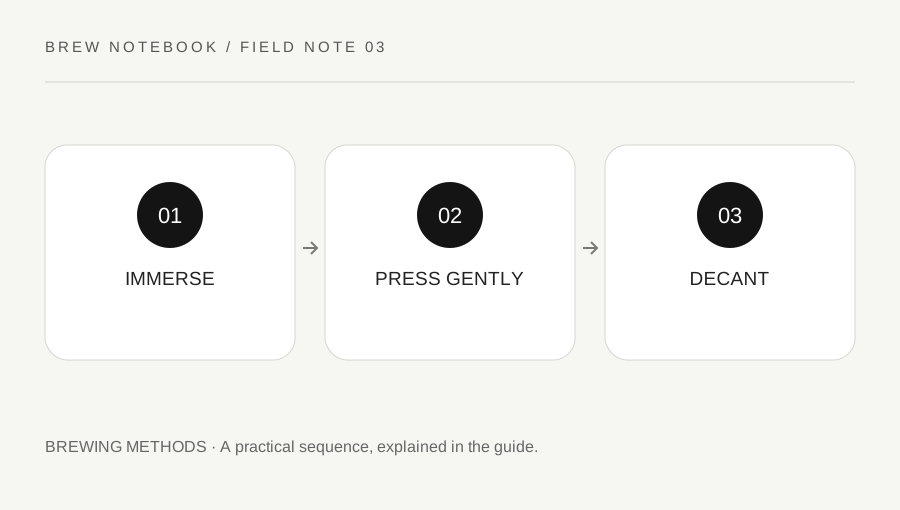
Original explanatory diagram. Numerical examples in this guide illustrate the reasoning; they are not a claim of hands-on testing.
Check capacity and the starting recipe
Read the press instructions and inspect the vessel and plunger for damage. Leave room for the lid and plunger; nominal capacity is not a promise that the press can safely hold that amount of water plus coffee. Put a glass press on a stable, protected surface.
Use the manufacturer recipe as the baseline. If you are planning an illustrative 30 g dose at 1:15, the input water is 450 g, provided the press has suitable capacity. Record dose, water, grind and contact time so the recipe is reproducible.
Handle the press gently
Add coffee and water according to the device instructions and keep track of the steeping time. Avoid striking a glass vessel with metal utensils. Fit the lid correctly and keep your face and hands clear of the spout when pressing. If the plunger resists, stop; forcing it can cause hot liquid to escape.
Pour the coffee into a separate vessel once the brewing stage is complete rather than leaving your entire serving on the grounds. A mesh filter allows more fine particles through than a paper filter, so some sediment is normal and does not by itself prove the recipe failed.
Troubleshoot texture and taste separately
If the texture feels gritty, consider grind consistency and how you pour the final portion. If the flavor feels too concentrated, review the ratio. If it tastes harsh, examine the contact time, grind and agitation rather than treating all harshness as a strength problem.
A useful comparison is to keep the same dose, water and timing, then decant carefully and leave the final sediment-rich mouthful behind. Compare that with your previous pouring habit. Clean the mesh assembly as the manufacturer directs, because retained grounds and oils make the next experiment harder to interpret.
Plan the serving and clean-up as part of the recipe
Imagine preparing a press for two people who will drink at different times. Leaving the second serving in the press makes the two cups less comparable because it remains with the grounds. If the device and recipe allow, decant the brewed coffee into a suitable separate vessel and serve from that instead.
Record how much input water you used and roughly how much drink you served. Some loss is expected, and a sediment-heavy final portion may be less appealing to you. Do not force every last drop through the mesh simply to make the output equal the input. The goal is an enjoyable serving, not a perfect-looking mass balance.
When the press has cooled enough to handle safely, remove grounds and clean the parts according to the manufacturer directions. Check how the mesh assembly fits back together. A retained pocket of grounds or oil can affect the next cup and make a grind experiment confusing. If the vessel or plunger is damaged, stop using it until the issue is resolved. Safe, repeatable handling belongs in the brew plan as much as the dose and steeping time.
A practical checklist
Tick items for your own use. This checklist is saved only in this browser.
Questions that come up
Can I force a stuck plunger down?
No. Stop and follow the manufacturer troubleshooting guidance. Force can send hot liquid out of the vessel.
Is sediment always a sign of bad coffee?
No. Mesh filtration differs from paper filtration. Decide how much texture you enjoy and pour accordingly.
Can I transfer one grinder number to another grinder?
No. Setting scales and grind distributions differ. Record the machine as well as the number and adjust from the actual result.
References & scope
Background references checked on 18 October 2026. The examples and practice exercises are original editorial explanations, not copied procedures or professional advice.