Build an AeroPress Baseline from the Supported Upright Method
A small coffee press can inspire many experiments, but the first useful record is a supported routine you can repeat safely. Identify the model, use a suitable vessel and keep the recipe labels clear.
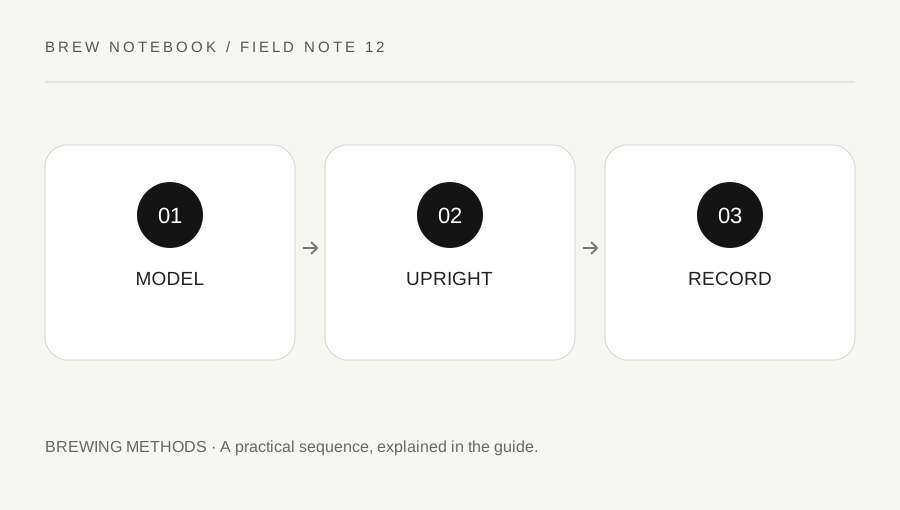
Original explanatory diagram. Examples illustrate a method or decision; they are not claims of personal testing.
Use the instructions for the actual model
AeroPress offers several models and accessories, so identify what you have before following a recipe. Read its current instructions for assembly, filter, vessel and use. An accessory-specific method should not be assumed to fit another setup. Keep the source instructions available rather than relying on a remembered sequence from a short video.
Choose a stable receiving vessel that the manufacturer considers suitable and follow the supported upright setup. Keep the work area clear and handle hot water carefully. Do not improvise a balancing arrangement or apply force to an unstable cup. A creative recipe is not a reason to ignore the physical requirements of pressing over a container.
Label dose, brewing water and later dilution
Write the dry coffee dose and the water used inside the brewing step. If the method includes adding water afterward, record that separately. Otherwise, two recipes can appear to share a ratio while using different extraction and dilution arrangements. The final drink quantity also differs from the water inside the brewer because the grounds retain liquid.
Follow the supported method for stirring and pressing. Do not force an unusually resistant press or continue when the setup feels unstable; use the manufacturer's guidance for the situation. Keep the first recipe simple so you can identify what changed when experimenting later. A clear baseline is more useful than combining several championship-style variations into one unrepeatable first attempt.
Work through a dilution record
Imagine a supported routine uses a coffee dose, a defined amount of brewing water and an optional later water addition to taste. The user records all three separately and labels the final addition as dilution. They do not call the brewing-water ratio identical to the total-water ratio without explaining the difference.
On a later attempt, they change only the later dilution while keeping the supported brew stable. That tests drink strength preference more narrowly than changing grind, brewing water and pressing technique together. These are conceptual examples, not a complete manufacturer's recipe or a claim that the same quantities suit every AeroPress model.
Finish with safe cleanup and a useful note
Follow the model's instructions for separating parts, ejecting used grounds, cleaning and storage. Keep hot components and the spent puck handled appropriately. Do not assume a cleaning method for one material or accessory applies to another. Inspect parts through the manufacturer's guidance and use the official route for damaged components.
Record the accepted model, filter, coffee, dose, brewing water, dilution and a concise preference. When you later experiment, retain this baseline so you can return to it. A useful coffee routine can be simple, with no promise that greater pressing force or a more elaborate method automatically improves the cup. Supported handling and clear measurements come before complexity.
Avoid comparing unrelated ratio definitions
A recipe described as concentrated and diluted later cannot be compared with a full-volume brew solely by its first water number. Write the dose, brew water and later addition in separate fields, then calculate a total only if that is the question. Keep the model capacity and supported method in view. This distinction helps explain why two recipes with similar final quantities may still use different processes. It also prevents a later change in dilution from being mislabelled as a grind or pressing experiment.
A practical checklist
Choices are saved in this browser. Reset them here or clear this site’s browser storage.
Questions that come up
Does later dilution belong in the same measurement as brewing water?
Record them separately, then state clearly whether a total-water calculation includes both.
Should I force a press that feels unusually resistant?
Do not force an unstable setup. Follow the manufacturer’s instructions for the actual model and situation.
Can every recipe fit every model?
No. Check capacity, accessories and supported instructions before transferring a recipe.
References & scope
Background references checked on 18 October 2026. Worked examples and diagrams are original teaching material.