Brew Decaf as Its Own Coffee Rather Than a Copy of Another Bag
A decaf bag still has a roast, source and brewing behavior worth recording. Start with a suitable method and compare it on its own terms instead of assuming one old grinder setting must work unchanged.
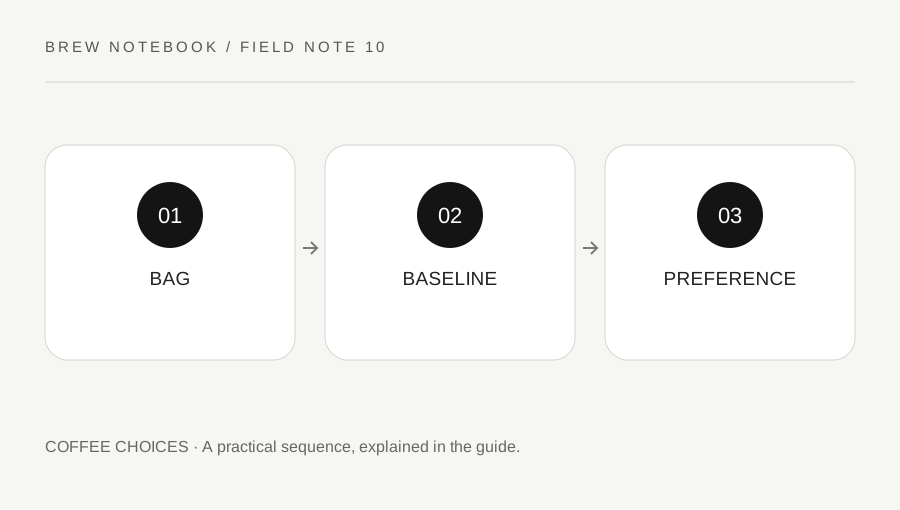
Original explanatory diagram. Examples illustrate a method or decision; they are not claims of personal testing.
Read the bag for usable brewing information
Record the coffee name, roast information available, grind form and any brewing guidance supplied by the producer. Keep the actual decaf label visible rather than replacing it with an assumption that all decaffeinated coffees are identical. The NCA describes decaf as a coffee choice available across varieties and brewing methods.
If caffeine content matters to a personal requirement, use reliable product and appropriate professional information. Decaf should not be assumed to mean a guaranteed zero-caffeine drink. This guide is about preparing and comparing coffee, not making a medical recommendation or promising that a particular serving suits a health condition.
Build a simple baseline
Choose a supported method and a reasonable starting recipe, then record coffee dose, water input and grinder reference where applicable. Keep the first attempt uncomplicated. If switching from another bag, note that the beans changed even if the brewer stayed the same. Do not attribute every difference automatically to decaffeination when roast and source may differ too.
Taste at a comfortable temperature and write a plain preference. If the cup needs adjustment, choose one variable using reliable method guidance. The goal is to establish a routine for the actual coffee rather than reproduce another bag's flavor exactly. Avoid claiming a universal decaf grind or extraction behavior from one example.
Use a two-bag comparison honestly
Imagine a user changes from a regular medium-roast bag to a decaf from another producer. The first cup tastes different. They record both bag identities and recognize that several coffee characteristics changed, so the comparison cannot isolate one cause. They then adjust the new coffee's brew method in a small controlled way.
If they later compare two decafs, they keep the same preparation where supported and label the cups. They describe the result as their preference under those conditions rather than a ranking of every decaffeination process. This is an illustrative home exercise, not a blind laboratory test or a health comparison.
Keep shopping and brewing expectations realistic
Use producer information and your own repeatable experience to decide which coffee you enjoy. Do not infer a specific process, origin or caffeine amount from a vague taste descriptor. If the label lacks information you need, ask the producer through its official route rather than filling the gap with an online assumption.
Store and handle the coffee through suitable ordinary guidance and keep the brew record linked to the actual bag. A useful decaf routine can be straightforward and enjoyable without a claim that it behaves exactly like every caffeinated alternative. The successful outcome is a supported cup you prefer, with factual product limits and personal requirements treated separately from flavor experimentation.
Keep the comparison free of a hidden label test
If another person joins a preference exercise, explain what is being compared and avoid treating their response as a test of whether they can detect decaf. A single informal tasting cannot establish that everyone will or will not notice a category difference. Use it to discuss the actual cups and their preparation. Keep any dietary or medical need handled through appropriate information rather than a surprise experiment. A respectful comparison can remain a small enjoyable brewing activity without becoming a universal claim about perception.
A practical checklist
Choices are saved in this browser. Reset them here or clear this site’s browser storage.
Questions that come up
Does decaf guarantee zero caffeine?
Do not assume that. Use reliable product information and appropriate advice where caffeine content is important to a personal requirement.
Must the old grinder setting work unchanged?
No. Treat it as a possible starting reference and establish a routine for the actual new coffee.
Can one different cup isolate decaffeination as the cause?
Not when roast, source or other coffee characteristics changed too.
References & scope
Background references checked on 18 October 2026. Worked examples and diagrams are original teaching material.