Home Espresso: Separate Dose, Beverage Yield and Machine Instructions
A useful espresso baseline records what went in and what came out. Start with the machine and basket instructions, then compare a small controlled change rather than chasing a universal shot number.
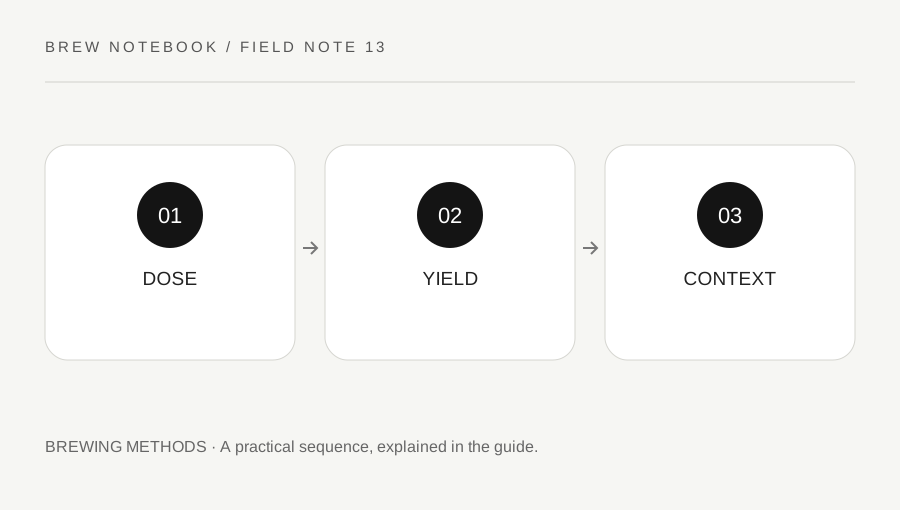
Original explanatory diagram. Examples illustrate a method or decision; they are not claims of personal testing.
Use the machine’s supported routine
Read the exact machine, grinder and basket guidance before choosing quantities. Espresso is a brewing method rather than a single required bean type, as the NCA explains. The equipment and coffee still matter to the practical recipe. Do not overfill a basket or alter machine components to force an online target.
Follow safe use, warm-up, cleaning and pressure-release instructions. Keep hands away from hot or pressurized components and use the proper service route for a fault. A general brewing log is not a repair manual. If the machine behaves abnormally, stop investigating flavor through recipe changes and address the equipment question first.
Keep the two weights clearly labelled
Dose is the dry coffee placed in the supported basket. Beverage yield is the liquid collected in the cup by weight. A ratio between those values is not the same measurement as a filter-coffee input-water ratio. Record the actual values and label the ratio definition rather than copying a number with no context.
Timing can be another observation, but note how you start and stop it. A timer beginning at a button press is not necessarily comparable to another routine beginning at first visible liquid. Do not use a precise time as the sole verdict on taste. Keep the method consistent enough that the measurements help explain the result rather than create a false impression of certainty.
Work through an illustrative ratio note
Imagine a supported setup records an 18-gram dose and a 36-gram beverage yield. The beverage-to-dose ratio is two to one. These are arithmetic examples, not a universal recipe recommendation. The user records the actual coffee, basket and timing convention and tastes the result at a comfortable temperature.
If they want to compare a modest change, they choose one variable under the equipment's guidance and keep the rest of the routine as consistent as practical. A grind change alongside a new coffee and a different basket is not a one-variable test. They mark such a session as a new baseline rather than claiming one factor caused the entire difference.
Keep taste, workflow and maintenance together
Use plain tasting notes and the practical handling result to decide which supported routine you prefer. Do not describe an unmeasured extraction percentage or diagnose every flavor from time alone. Keep any maintenance action separate in the record because a cleaned or repaired machine can change the comparison too.
Follow manufacturer instructions for backflushing, descaling or other maintenance only where they apply to the model. Do not mix cleaning products or improvise a stronger procedure. A useful home espresso record is compact and honest: supported setup, dose, yield, timing convention and preference. It should make the next cup easier to understand without promising a single perfect ratio for every coffee and machine.
Keep milk or other additions separate
If the drink will include milk or another addition, assess and record that serving step separately from the espresso baseline. A preference for the completed drink does not reveal a precise cause inside the shot. Use appropriate ingredient handling and the equipment's instructions for any steaming function. Do not change shot preparation and every serving proportion simultaneously while claiming a one-variable comparison. A clear record can include both the supported espresso and the final drink, with each quantity labelled for what it actually represents.
A practical checklist
Choices are saved in this browser. Reset them here or clear this site’s browser storage.
Questions that come up
Is espresso ratio the same as input-water filter ratio?
No. State what the numerator and denominator represent. Beverage yield and input water are different measurements.
Does a target time guarantee good espresso?
No. Use timing as context alongside supported preparation and actual taste.
Can a recipe fix an abnormal machine?
Do not use flavor experiments as a repair process. Stop and follow the official equipment support route.
References & scope
Background references checked on 18 October 2026. Worked examples and diagrams are original teaching material.